Jan 2021 to Aug 2022Weeks after the December 2020 listing
Impact
Blueprint became substrateReviewed across five platform teams
01The situation
Dec 2020 to mid 2021
At the 2021 launch pace, an internal projection put a single frontline role on track to manage over 400 alert channels by year end.
Support escalations crossed 2,000 a week.
Company’s public record. Context, not credit.
Launch was a solved problem. The day after launch was not.
I joined weeks after Opendoor’s December 2020 listing as a senior product designer on the operations platform. The company was in 21 markets and had committed publicly to doubling that footprint within the year. It got there: 44 markets by September 2021, 51 by mid 2022, with annual revenue more than tripling, $2.6B in 2020 to $8.0B in 2021.
Six markets could open in a single day. On the Q2 2021 earnings call, Opendoor’s President described “shifting resources away from incremental market launches” toward scaling operations in the markets that already existed. Operations capacity, not launch capability, had become the binding constraint. I was hired into that gap.
Inside, the seams showed. The operating layer everyone stood on was a patchwork of tools that had grown with the company, and faster than it. Coordination ran through chat because no system owned the handoff.
02The investigation
Apr 2021 to Q1 2022
Three studies: a current-state study of Sales and Support (April to May 2021, 20 sessions), operator authorization research (January to February 2022, 7 sessions), and a renovation management discovery (Q1 2022, 8 operators).
Methods: interviews, shadowing, and an audit of every tool operators touched.
Thirty-five sessions with the people the org chart called support.
The same question sat under every session. What does an operator actually do, and what does the tooling assume they do. The two answers rarely matched.
Proficiency
Becoming proficient took months, and efficiency stayed low even after.
Context
Context on a transaction and customer lived across systems and in people’s heads.
Human dependency
Almost every transaction needed a person to push it along, and often an engineer too.
Insight
Measurement came last, so optimization never came.
Change
Processes changed faster than the tools that ran them.
Handoffs
Work moved through chat and memory.
Fig. 01 · One work order, seven steps, four tools. Redrawn from the current-state research. Step sequence as documented; tool names generalized.
Sending one work order, as observed
Receive market assignmentspreadsheet
→
Filter upcoming projectsweb console
→
Check disposition typeadmin
→
Search home addressadmin
→
Send line itemsadmin
→
Create empty work ordersweb console
→
Send to vendorsweb console
Context was hand-carried across every seam. Onboarding a new operator meant teaching the seams before the work.
What am I supposed to do next?
A field operator, mid-workflow. Research session, Q1 2022
03The blueprint
Q2 2021
Presented at a June 2021 product review.
Twelve capabilities, and one rule about what it costs to change them.
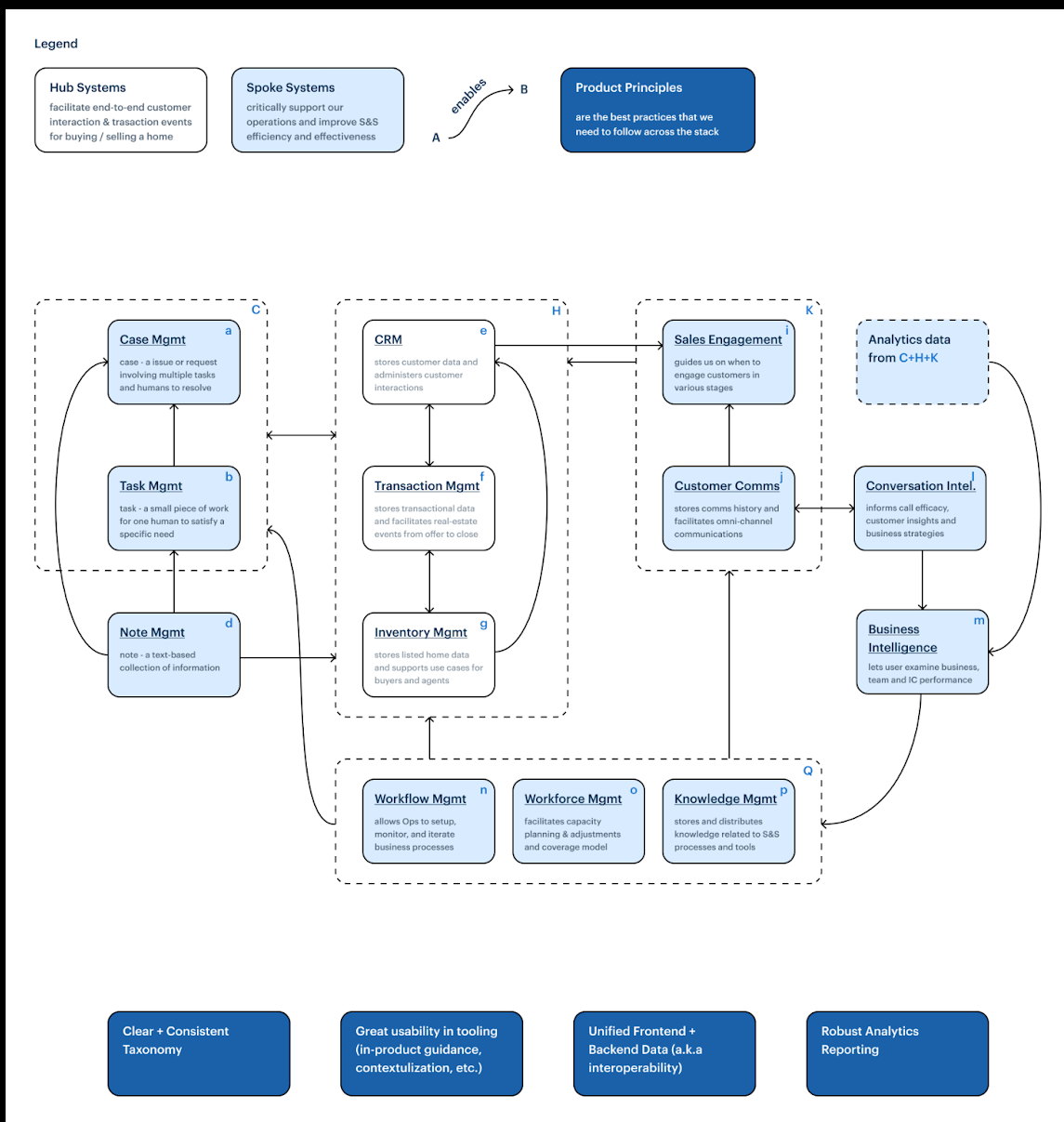
The end state drew Sales and Support as a hub and spoke system. Three capabilities formed the hub: customer management, transaction management, and inventory management. Nine spokes sat around them, from sales engagement to business intelligence.
One rule came attached. Changing a hub component was a Type 1 decision, expensive and nearly irreversible. Changing a spoke was cheaper, and expected. That one distinction told every later team where to be careful and where to move fast.
Fig. 02 · The logical end state, as authored. Hub systems carry end-to-end customer and transaction events; spokes support the operation around them. Cropped from the 2021 blueprint document; capability labels as written.
The argument for the blueprint was speed. Without a system to work backward from, every team would keep solving its own corner, and the seams would keep multiplying. That was already happening.
04The decision
Aug to Q4 2021
An August 2021 product review: the first buy-versus-build gate downstream of the blueprint.
The scope discipline held. Ticket management was bought. Transaction task management, the differentiated core, stayed out of the purchased tool’s scope.
The blueprint’s first real job was talking the company out of building something.
The first component to hit the gate was customer ticket management. Support escalations crossed 2,000 a week, all of it moving through chat, none of it tracked anywhere central. The blueprint made the decision legible. Ticket management sat in the spokes, commodity territory where mature products already existed. So I argued for buying. Integrate a commercial ticketing system with the existing telephony stack rather than build one in house.
Prototype in early September. Beta by the end of Q3, first version early Q4. Three categories were explicitly out of scope for the purchased tool, transaction task management first among them. The differentiated work stayed on the platform roadmap, where the blueprint said to build.
Before · escalations in chat
No centralized tracking of issues or statuses
Context rebuilt at every handoff
Escalations resolved by whoever saw them
No measurement of resolution
After · V1 on a bought system
01Every general support voice and SMS issue tracked
02One queue replacing the alert channels
03Handoffs and resolution measurable end to end
Buy the commodity. Build the differentiator.
05What remained
Nov 2021 to Aug 2022
Q1 2022: a CRM requirements document mapped 37 needs across four operator roles to the platform teams that would own them.
The blueprint turned into an address system.
Through late 2021 and 2022 the work became substrate. An engineering proposal to consolidate operator identity and authorization, the layer every tool sits on, went to review across five platform teams. In January and February 2022 I co-authored the operator authorization research on that same layer. Seven sessions with operations managers and leads.
The last thing I worked on was the generalized UI framework for internal tooling. Its first stated assumption was that the framework depended on the authorization work underneath it. The blueprint’s layers had become explicit dependencies.
Fig. 03 · The generalized UI framework. One vocabulary for every internal tool, with modules that respond to system signals. Redrawn from the 2022 framework document.
From shared parts to signal-aware surfaces
Componentssmallest shared parts
→
Widgetscomposed interactions
→
Modulessignal-aware blocks
→
Index viewsDetail surfacesDashboards
Modules change what they display based on role, surface, and transaction model. The UI reads the system so the operator does not have to.
By the time I left in August 2022, requirements documents routed work to platform teams by name: transaction, tooling, buyer, seller. The organization had reshaped around the platform view the blueprint drew. That was the intent.
The foundation was still open when I left. The authorization layer everything else sat on was in discovery, and the engineering design doc for it had a reviewer sign-off column with nothing in it. My own research on that layer, finished a month before I went, was still asking what operators needed from access and permissions. I got the ticketing system to V1. The rest I handed over unfinished.
35
Operator research sessions, three studies
2,000+
Weekly support escalations at the start
12
Capabilities in the blueprint: 3 hub, 9 spokes
5
Platform teams reviewing the substrate
Scope and stakes, not outcome claims. Market and revenue context is the company’s public record.
The measurable wins belong to the teams that shipped against the blueprint after I left. What I can claim is the seeing. A company’s operations, made legible enough to organize around. Twenty months of that, and the last document I worked on opened by naming what it depended on, which was work other people owned.