Pinterest · Business Navigation · Q4 2022 to Q4 2024
One navigation for Pinterest’s ads tools.
Eight organizations owned pieces of the ads platform, and the menu was organized by team. I led the work to reorganize it around advertiser jobs, from research through general availability.
Role
Senior Product Designer to Staff Product DesignerDesign lead for the workstream · initiated it
Company
PinterestAds Experience · Monetization
Timeline
Q4 2022 to Q4 2024Discovery through GA launch
Impact
25% fewer nav opensSame page visits, faster pathfinding
01The stakes
Q4 2022
Page visit logs from 4,786 enterprise accounts showed advertisers skipping the Overview home page and going straight to Reporting, presumably from a bookmark.
Enterprise agencies rated proficiency on the platform less transferable than Meta or Google.
Advertisers went straight to the page they needed and skipped the navigation.
Four dropdowns, side by side. Each one built around the team that owned the tools inside it. The menu was an org chart. To find something, a person had to already know which team owned it. When people leave your product to Google how to use your product, the navigation has failed.
Before · four dropdowns
Business
Create
Analytics
Ads
Each organized around an internal team
After · one MegaNav
01Create Content
02Manage Campaigns
03Analyze Performance
04Manage Business
Scanning one container is faster than hunting through four.
Four layers. UI, information architecture, taxonomy, context. Each demanding more organizational commitment than the last.
The framing that made it shippable in weeks
02The program
2023
I started the workstream and ran the first milestone myself, before a PM joined.
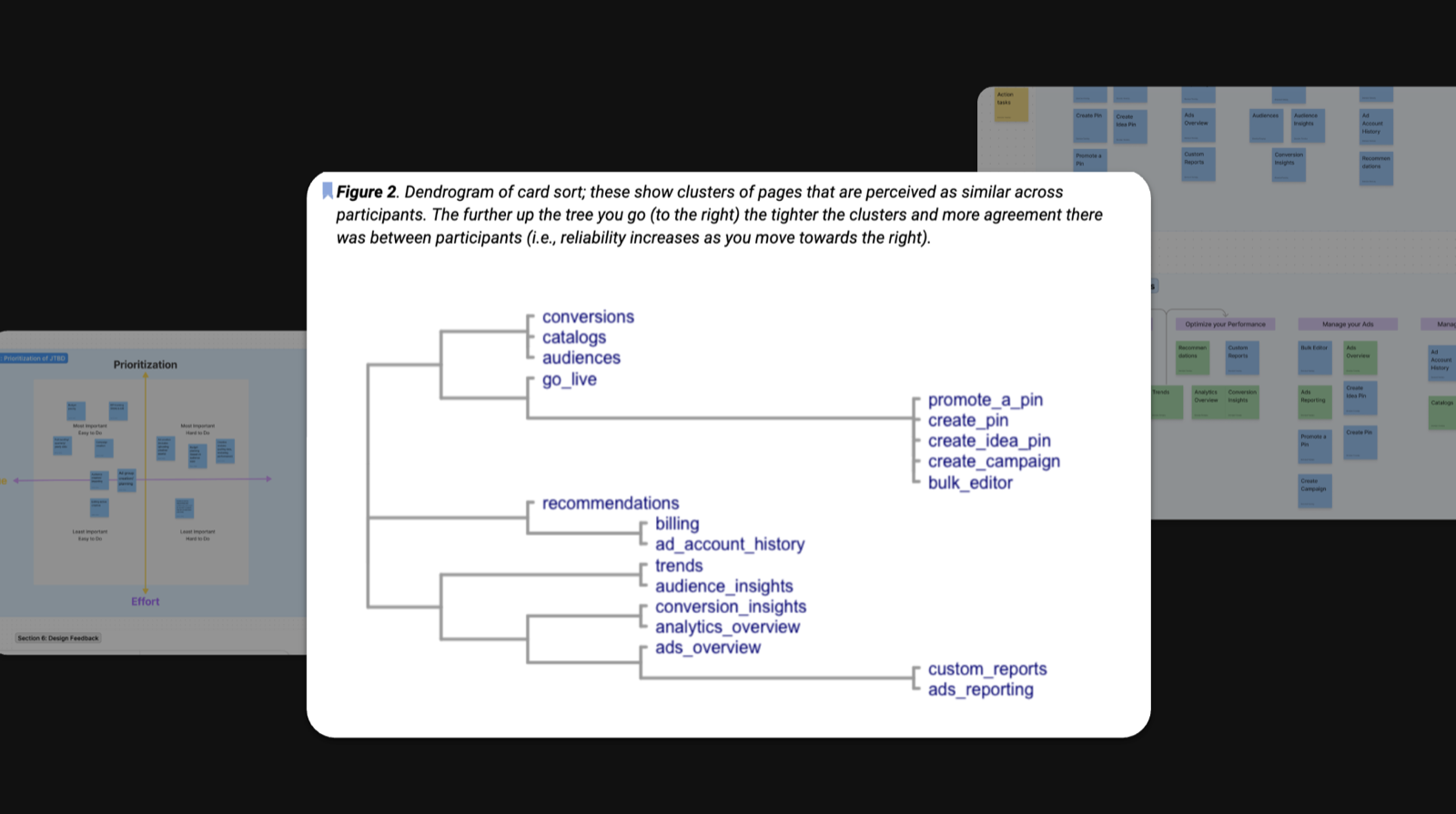
Two formal IA studies with our UX research partner, using card sorts and dendrogram analysis across 24 participants in three segments, Enterprise, SMB and Creator.
Two years, four milestones, no PM for the first one.
Scoping, the measurement framework, experiment design, stakeholder alignment, launch. For the first milestone that was all one job, and it was mine. When a PM joined for M2, I put the time that gave me back into navigation governance, which nobody had asked for.
Research
Competitive audits across Meta, Google, Snap, and TikTok. An internal inventory of every tool and landing page, covering 12+ tools, 8 orgs, 4 team owners and 3 advertiser segments.
Measurement
Every surface classified as action or browse oriented, with a three-tier evaluation model, so every experiment signal was interpretable.
M1, MegaNav
The first experiment tested multiple siloed menus against a single view with multiple columns. Same content, new container. Launched July 2023.
M2, structure + Shortcuts
Columns reorganized from platform taxonomy to jobs-to-be-done, with customizable Shortcuts as the personalization mechanism inside the universal structure.
Governance
Originated a 10-step submission process with weighted evaluation criteria for what belongs in global navigation, workshopped across six functions, then handed to the design program management team to own.
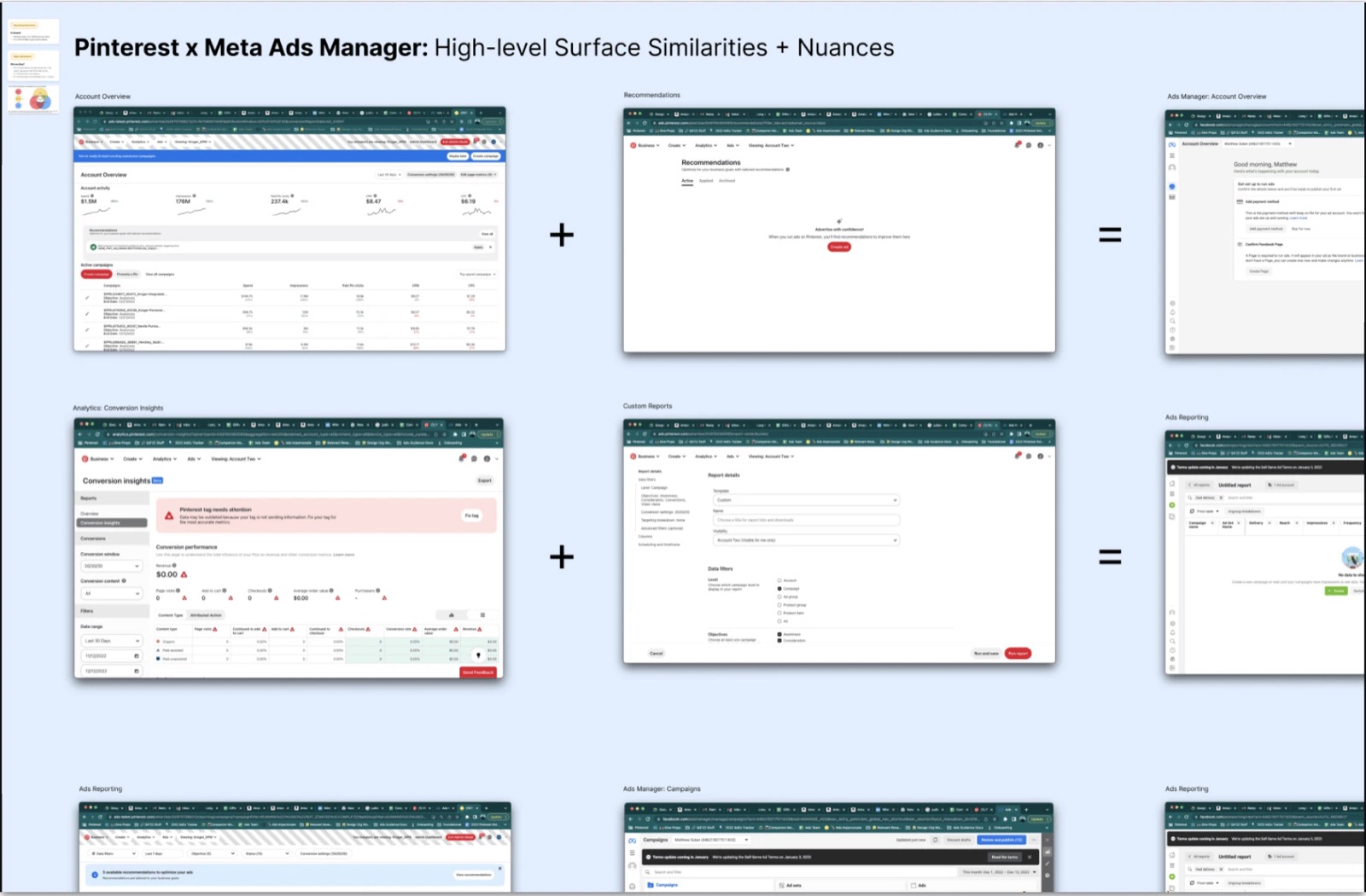
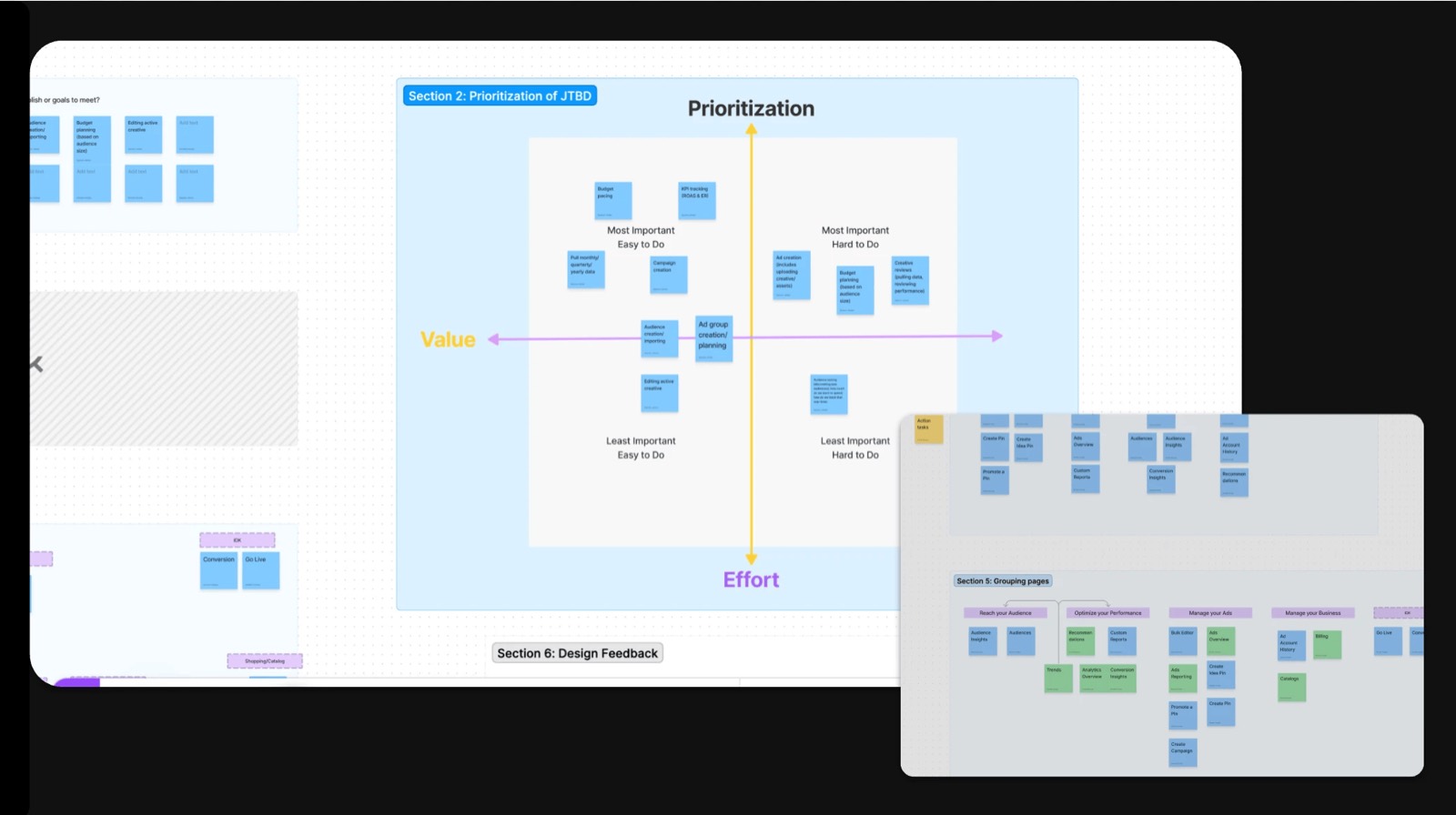
Fig. 01 · Competitive audit. Pinterest surfaces mapped against their Meta Ads Manager equivalents by entry points, hierarchy depth and how tools are organized.Fig. 02 · Research synthesis. Jobs-to-be-done prioritized on value and effort, then every page grouped into the four workflow categories that became the new columns.Fig. 03 · Dendrogram analysis. Card sort clusters showing which pages participants perceived as belonging together. Across 24 participants, three distinct mental models. Enterprise oriented around campaign control, SMB around operational efficiency, Creators around content distribution.
03Shipped
Jul 2023 to Q1 2024
Managed advertisers pinned paid campaign surfaces, and unmanaged ones pinned organic content. One feature generated the behavioral signal stated-preference research could only approximate.
Design leadership held the platform to one IA for every advertiser segment. The card sorts had turned up three different mental models.
The container shipped first. The structure underneath it waited. Personalization came third, activation last.
M1 reached general availability by Q1 2024. M2 reorganized the columns around advertiser jobs and added customizable Shortcuts. Managed advertisers, the segment the revenue comes from, went to the surfaces closest to spend more often. Reporting was up 18%, Custom Reports up 18%, Create Campaign up 9%.
Segment specific navigation never got built. That was the constraint I was handed, so I designed for the workflow patterns all three segments shared and made Shortcuts the place the differences could live.
One number moved the wrong way. M2 showed a 1.61% dip in campaign creates. I put the tradeoff in context and recommended a mitigation before we ramped to 100%.
The mitigation was one change. Create Campaign moved to the top of its column. The dip was measured before the ramp, so I was recommending on partial data. Then we went to 100% and I moved on to the next milestone. Nobody ever sent me the number, and I never went looking for it.
Fig. 04 · IA restructuring (M2). Columns shift from internal taxonomy to advertiser workflow. Hovering reveals in-product descriptions authored with Content Design.
0:00
Fig. 05 · Shortcuts (M2). Customizable navigation entry points. People pin their most used surfaces, drag to reorder, and see selections persist across sessions.
0:00
−25%
Nav opens, visits held
+18%
Managed reporting engagement
2,600+
Advertisers adopted Shortcuts
8
Orgs aligned on one nav
“I live and breathe in the MegaNav. It is just the best. Everything is so easy to find. It is very robust.”
Enterprise advertiserUnsolicited, during an unrelated research session
04The governance
2024 onward
The criteria are weighted. A request can be declined with a score instead of an opinion.
The governance system kept operating after my involvement ended. That was the intent.
Teams kept asking to put their surface at the top level, one request at a time, each one reasonable on its own. Without criteria for what belongs in the navigation, the work would erode within months of shipping.
Governance is the boring part of this case. Somebody who wants into that navigation still has to fill out a form. An advertiser called the result robust, which is not a word anyone sets out to design for.