Meta · Audience Management · 2019 to 2020

Three platforms became one.

Targeting had to get smarter while learning less.

Role
Lead DesignerWith PM · UX Research · Engineering
Company
Meta (then Facebook)Ads Manager · Audience Manager
Timeline
2019 to 2020Search · Usage · Consolidation
Impact
3 platforms → 1Reduced duplication, increased search adoption
01The stakes
2019

Three versions of Audience Manager lived across four URLs.

Advertisers had built elaborate robotic naming conventions on top of a tool that should have handled organization natively.

Enterprise advertisers ran tens of thousands of audiences powering millions in revenue. The product could not keep up.

Custom Audiences and Lookalikes were core to how enterprise advertisers targeted spend, but the product offered no scalable way to organize, search, or understand usage at volume. Advertisers wasted hours recreating audiences they couldn't find, or duplicating audiences because they couldn't tell where existing ones were running.

Before · three surfaces, no visibility
  • Three versions of Audience Manager
  • Spread across four URLs
  • No view of where an audience ran
  • Filters present but unused
  • Naming conventions doing the tool’s job
  • Defensive copies piling up
After · one surface, usage visible
01One unified Audience Manager
02Every audience mapped to campaigns and ad sets (groups of ads sharing a budget)
03Search by name, label, and event
04Cross-team and partner usage in view
Reuse became safer than copying.

When advertisers build their own system around yours, yours isn't working.

The failure signal that set the priorities
02Two tracks
2019 to 2020

Quant data showed high context-switching between the Audience and Ad Set pages; filters were valuable when prompted, untouched unprompted.

That pointed at awareness rather than capability, and it set the priorities for both tracks.

Two tracks, one surface. Usage visibility and search, designed in parallel.

I worked across product management, UX research, and engineering to synthesize the research, prioritize the workstreams, and design solutions on both tracks at once.

Usage panel

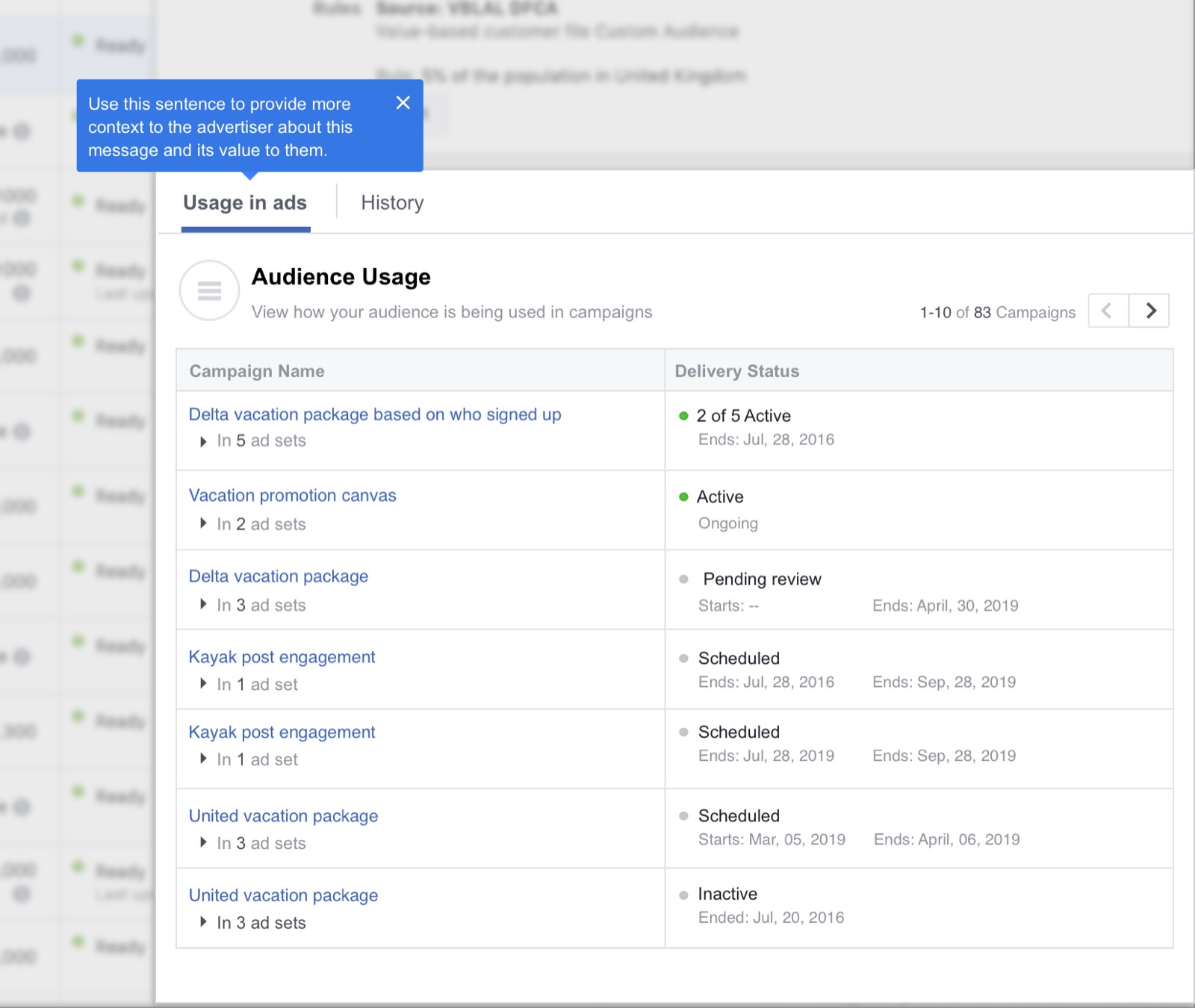
A new surface showing how any audience maps to active campaigns and ad sets, with campaign dates, delivery status (whether ads are actively running), and cross-team and partner usage. It gave advertisers the confidence to reuse audiences instead of duplicating them.

Search

Removed unsupported filter types, introduced Events filtering with standard events plus a custom catchall, elevated search placement, and redesigned filter communication so each filter describes its use case concretely.

Consolidation

Three versions of Audience Manager across four URLs became a single unified surface, adopting FDS standards and moving toward Geodesic component patterns.

The vision

Authored where audience management goes next: performance insights connected to campaigns, behavior-based search, bulk actions, lifecycle indicators. The document became the roadmap reference that outlived the project.

Fig. 01 · Audience Usage Panel. Any audience mapped to the campaigns and ad sets running it, with delivery status and dates, without leaving the page.Account and campaign names shown are demo data.
Audience Usage Panel mapping an audience to its campaigns.
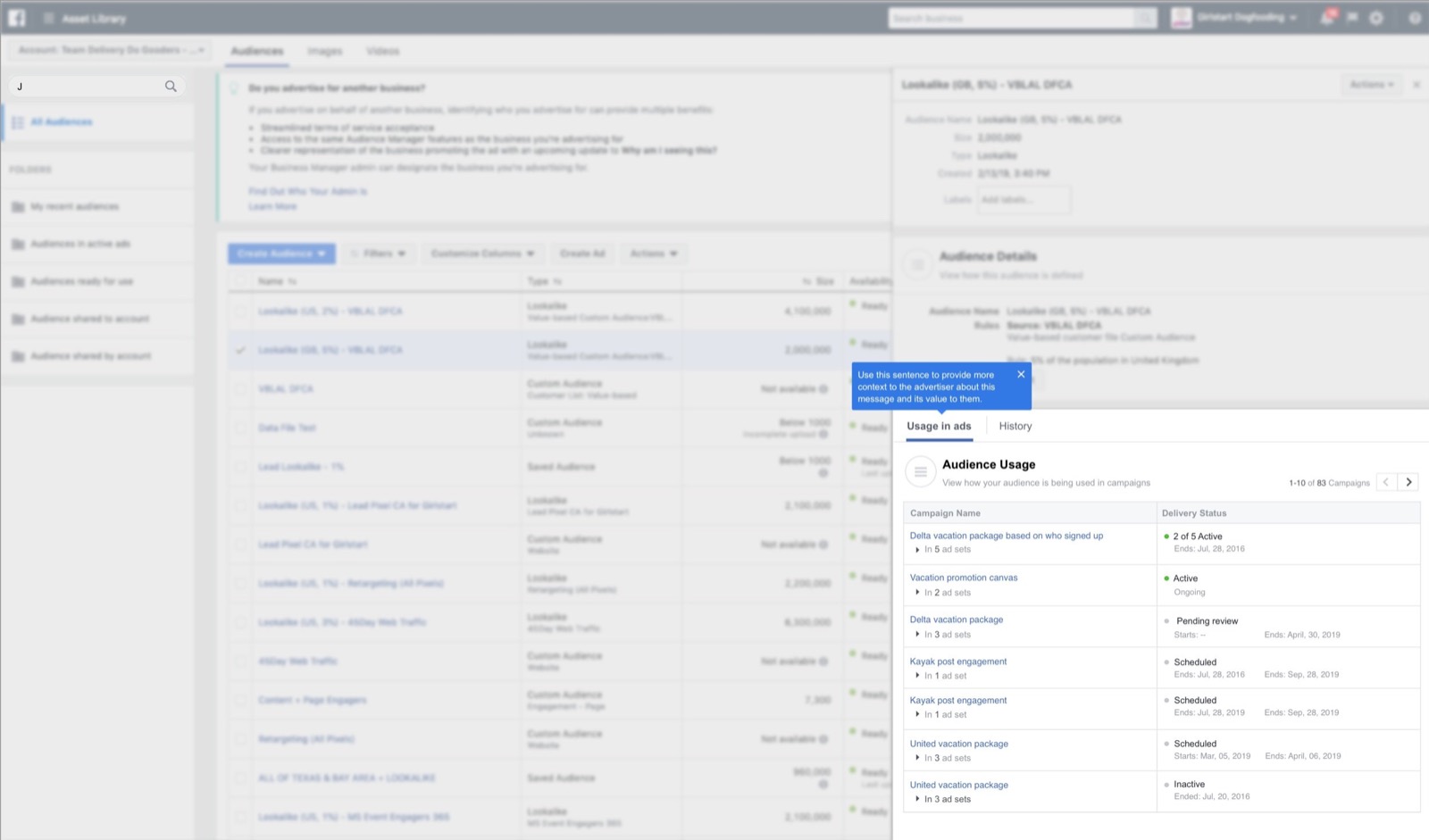
Fig. 02 · Usage detail. Campaign-level view with ad set counts, delivery status, and scheduled windows, plus a History tab for the audience itself.Account and campaign names shown are demo data.
Usage detail view with campaign-level breakdown.
03Shipped
2020

Two directional success signals: less context-switching between the Audience and Ad Set pages, and fewer total audiences per account over time.

Dead filters came out, Events filtering went in, and the whole surface aligned to the same design standards.

Advertisers could finally answer basic questions about their own audiences.

Is this audience in a campaign right now? How many ad sets does it power? Did a colleague or agency partner already use it? If I change it, what breaks? Without answers, advertisers copied audiences defensively, and accounts accumulated thousands of redundant audiences. The Usage Panel answered those questions in place, with the first cross-team and cross-partner view of who else was using an audience.

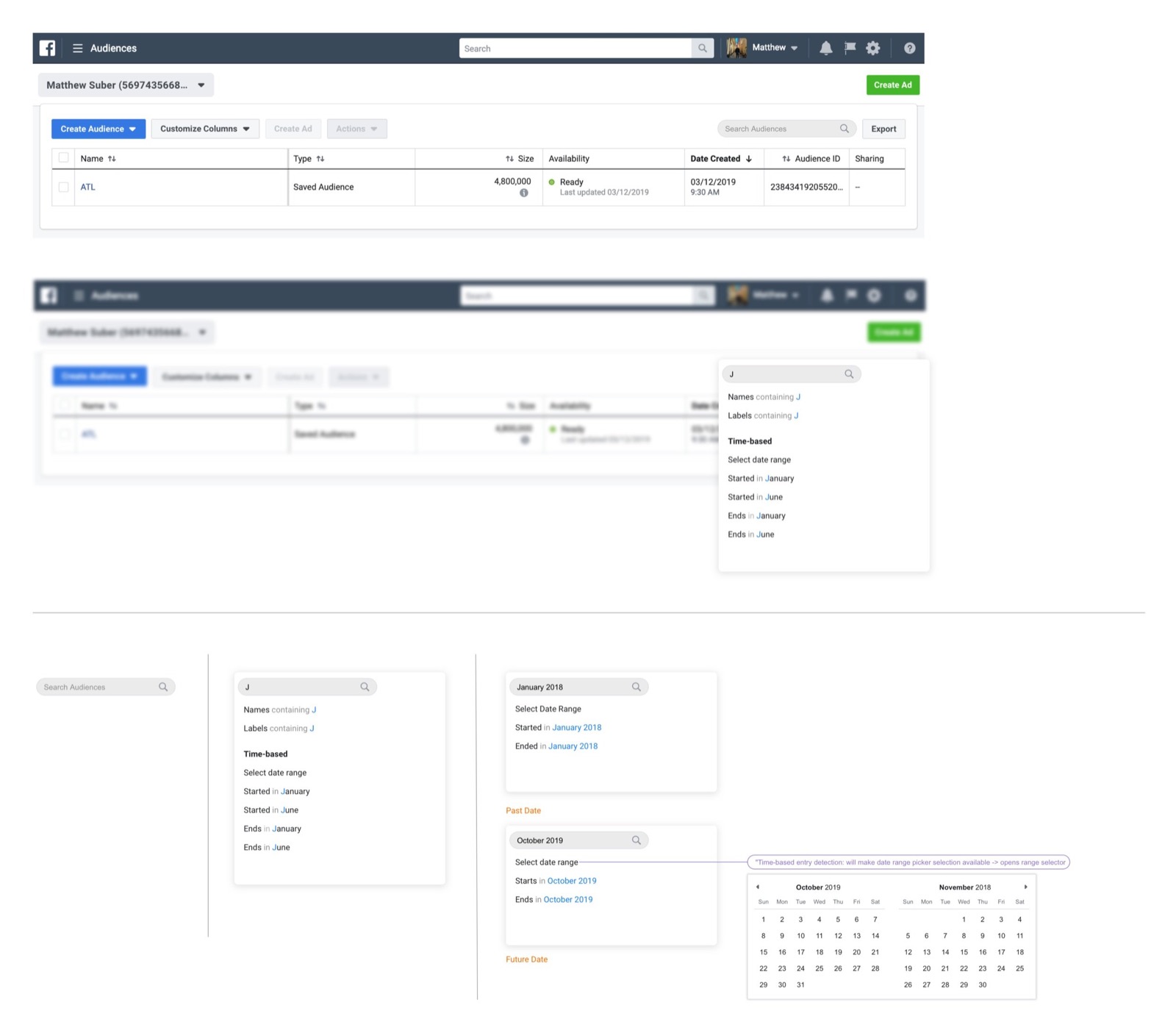
Fig. 03 · Search exploration A. Typeahead matching audience names and labels, with time-based queries detected in place and a date range picker opened when one is entered.Account and campaign names shown are demo data.
Search exploration with typeahead and time-based queries.
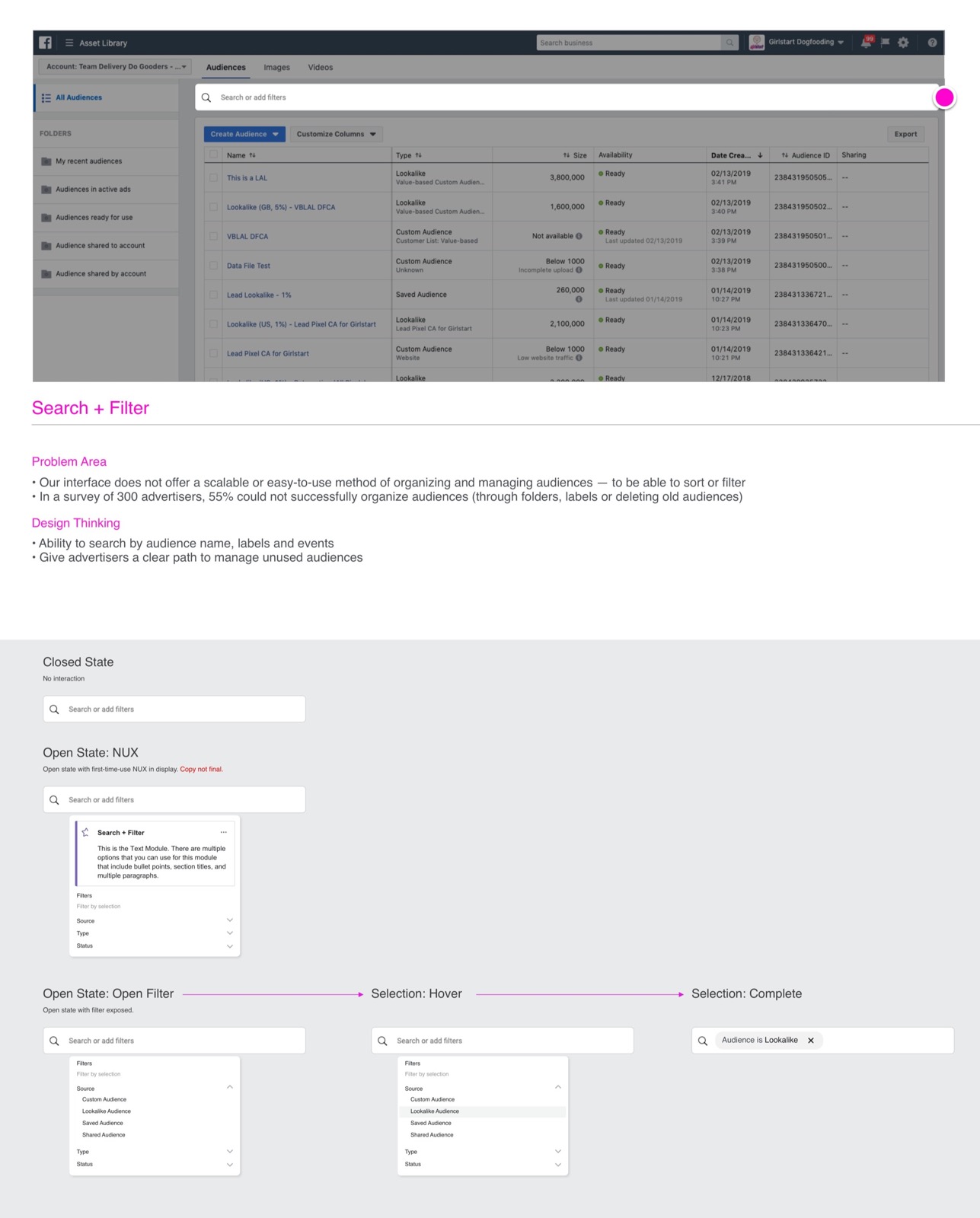
Fig. 04 · Search exploration B. One search-or-add-filters bar with progressive states: closed, first use, open filter, and applied selection.Account and campaign names shown are demo data.
Search exploration with a progressive search-or-filters bar.
3 → 1
Platforms consolidated
Audience duplication
Search and filter adoption
04What it changed
2020

The wins stayed directional by design: define the signals, watch the direction, skip the headline claim.

The most expensive behavior in the system was defensive duplication. Advertisers weren't making bad decisions. They were making rational ones, given what the product showed them, which was almost nothing.

The measurable outcomes were behavioral: reduced context-switching, reduced duplication, increased filter adoption. Design decisions were judged against how people acted, not how they felt about the interface.

Next case study Campaign Recommendations The framework any team could ship with. The platform standard at Meta. Read →
Contact