Staff Product Designer, Design Lead
Pinterest · 2024
Product strategy, system design, XFN alignment
Ads Automation · Campaign Creation · Lower-Funnel Optimization
~10% CPA improvement · $1M/week incremental · $523M platform revenue
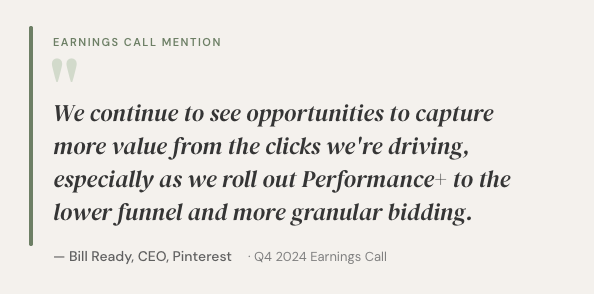
Performance+ is Pinterest’s flagship automation suite—and a centerpiece of the company’s quarterly earnings narrative. I led design from pre-work through 100% rollout, establishing design as a strategic partner to the ML and engineering teams building the system.
Industry Performance:
• P+ campaigns outperform traditional campaigns by nearly 80% in A/B testing
• Advertisers using P+ creative see 19% more checkout revenue
• 20% lower CPA for catalog sales campaigns with 50% fewer inputs
The Situation
When I joined the Performance+ initiative in early 2024, it was a mess.
Multiple teams were executing in different directions. Engineering had one vision for how the automation should work, Growth had another, and Product Marketing was promising advertisers capabilities we hadn’t designed yet. There was no shared mental model of how the system should behave—or how advertisers should understand and trust it.
The stakes were significant. Performance+ was Pinterest’s answer to Meta’s Advantage+ and Google’s Performance Max—automated campaign types that were capturing billions in ad spend by promising better results with less effort. Pinterest was late, and the gap was costing us budget share with sophisticated advertisers.
But automation creates a fundamental tension: the more the machine decides, the less control advertisers feel. And advertisers who don’t understand what’s happening don’t trust the system. They pause campaigns too early. They blame the platform when results fluctuate. They move budgets elsewhere.
My job was threefold: establish design as a strategic partner to BE/ML, create the frameworks that would align cross-functional execution, and ship a product advertisers would actually trust.
What I Did
Establishing Design as a Strategic Partner
The first challenge was getting design involved early enough to matter. The BE/ML teams weren’t accustomed to having a designer embedded in technical architecture decisions. I had to demonstrate that design input at the system level would save time and rework downstream.
I started by creating foundational diagrams—visual representations of how the system actually worked, translated from engineering complexity into stakeholder-legible concepts. These became the shared mental model that grounded every cross-functional conversation.
[Image: Foundational System Diagram]
The system diagram I created to align cross-functional teams on an understanding of P+ strategic place in the platform, higher-level UX implications, and where it may fit in the advertisers mental model.
Navigating the Automation vs. Control Tension
The core design challenge was philosophical before it was visual: how much should the machine decide versus the advertiser?
I developed the Optimal Setup Framework—a system that maps advertiser goals and spend levels to intelligent defaults. Instead of exposing dozens of configuration options, we ask advertisers what they’re trying to achieve. The system translates intent into configuration. This preserved advertiser agency without requiring expertise.
[Image: Optimal Setup Framework]
The Optimal Setup Framework: mapping advertiser intent to system configuration.
[Image: P+ Campaign Creation Flow]
The P+ campaign creation flow—simplified setup that preserves advertiser agency.
Designing for Trust During Uncertainty
Automation fails silently. When a P+ campaign underperforms in its first week, the advertiser doesn’t know if the system is broken or still learning.
I proposed the Learning Phase indicator—UI that sets expectations during the optimization period. When a campaign is new, we explicitly communicate: “Your campaign is in its learning phase. Performance may fluctuate as the system optimizes. We recommend waiting before making changes.”
This wasn’t just a label. It was a behavioral intervention. By naming the phase and setting expectations, we reduced premature pauses—protecting revenue and giving the system time to optimize.
[Image: Learning Phase UI]
The Learning Phase indicator—setting expectations to prevent premature campaign pauses.
Driving Cross-Functional Alignment
P+ touched Growth, Ads Quality, Monetization, Engineering, PMM, and Sales. Alignment required more than good designs—it required creating forums for coordinated decision-making.
I initiated the weekly Bidding Meeting—a cross-team sync coordinating P+, Bid Multiplier, ROAS Bidding, and LTV signals work. I was also a key contributor to the “Triple-A” adoption strategy—the go-to-market plan for rolling P+ to advertisers.
Key Decisions I Drove
Optimal Setup over manual configuration. Instead of exposing every lever, we ask advertisers what they want to achieve and configure the system for them. This reduced setup friction, improved adoption, and preserved the feeling of agency without requiring expertise.
Learning Phase indicator shipped to 100%. Advertisers were pausing campaigns prematurely because they didn’t understand early performance fluctuations. The indicator set expectations and protected revenue.
Fine-tuning as a separate layer. P+ is full automation, but some advertisers want more control. Rather than compromise P+ with manual overrides, I advocated for Value Expression and Bid Multiplier as the “fine-tuning” layer—separate capabilities that work with P+, not against it.
Foundational alignment before feature design. I invested early weeks in diagrams and frameworks rather than UI. This felt slow but paid off: the shared mental model reduced thrash and accelerated every subsequent decision.
Impact
~10% CPA improvement
$1M/week incremental revenue
$523M platform revenue (~33% of daily lower-funnel spend)
$104M Q4 2024 contribution (combined with Bid Multiplier)
100% GA rollout
CAPACITY BUILDING
Shipping P+ revealed gaps in the platform’s ability to guide advertisers when they deviated from optimal setup. I scoped and initiated adjacent workstreams.
Mid-flight recommendations. If an advertiser opts out of P+ defaults and makes suboptimal choices, the platform should intervene. I developed the framework for performance recommendations that quantify payoff tied to stated goals—showing advertisers what they’re leaving on the table.
Campaign status as entry point. I broadened the status indicator in the reporting table from a health signal to an information center surfacing when campaigns need attention—creating a pathway to recommendation adoption.
Guidance Framework. I led the effort to classify guidance types (descriptive vs. prescriptive vs. guardrails) and define the advertiser journey from awareness through adoption. This positioned the Guidance team to scale without reinventing the wheel.
Where This Fits
Performance+ is the “full automation” layer of an Advertiser Automation Spectrum I’ve been building at Pinterest:
• Full Auto (P+): Set a goal, we handle the rest
• Fine-Tuned (Value Expression, Bid Multiplier): Express what matters more
• Recommendations (Learning Phase, Guidance): Here’s what we suggest
• Manual: You control everything
Related work: Value Expression · Bid Multiplier
Navigating the Automation vs. Control Tension
The core design challenge was philosophical before it was visual: how much should the machine decide versus the advertiser?
I developed the Optimal Setup Framework—a system that maps advertiser goals and spend levels to intelligent defaults. Instead of exposing dozens of configuration options, we ask advertisers what they’re trying to achieve. The system translates intent into configuration. This preserved advertiser agency without requiring expertise.
[Image: Optimal Setup Framework]
The Optimal Setup Framework: mapping advertiser intent to system configuration.
[Image: P+ Campaign Creation Flow]
The P+ campaign creation flow—simplified setup that preserves advertiser agency.